Unlocking local insight at scale: How T-Mobile uses synthetic data to reach niche audiences


From national data to granular local insights
1 min read
21 → 98 markets
local insights at scale
35% → 70% coverage
of US 18+ population
~3× effective sample size
on low-incidence segments

Play video
How T-Mobile Made Niche Audiences Measurable at the Local Level
The problem
Reaching niche audiences is a persistent challenge in quantitative market research. Even with large national samples, results quickly become unreliable once data is cut by region, demographics, or behavior. Sample sizes fall, error margins grow, and local decisions are often made with limited confidence.
This is the situation T-Mobile faced in its local brand measurement work.
National data, local questions
T-Mobile runs nationally balanced brand tracking studies with tens of thousands of respondents each year. At the total level, these studies perform well. But local marketing teams need local answers.
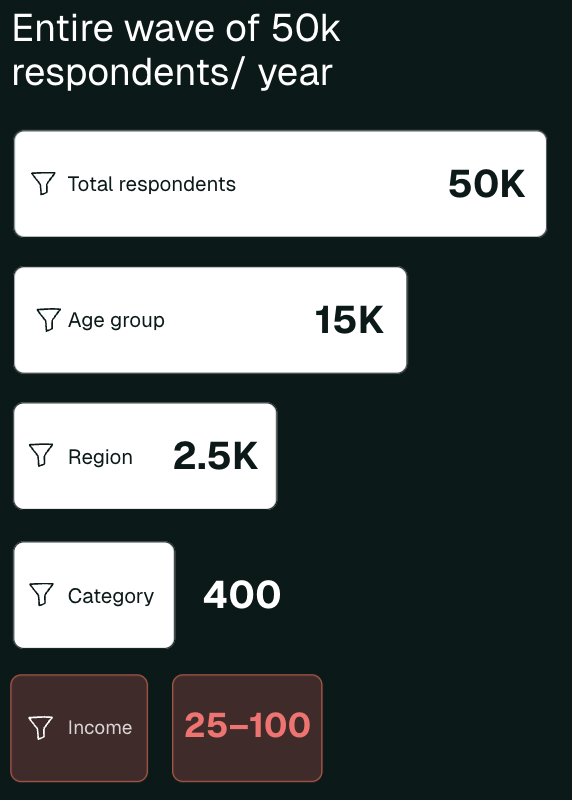
Understanding differences between markets like Miami, Phoenix, or Louisville requires slicing data by geography and audience attributes. Those cuts shrink fast. What starts as a 50,000-respondent dataset often becomes n=25–100 for the segments that matter most.
“None of what we did was doable until we found a way to survey the unsurveyable.”
Antoinette Sandy, Senior Data Scientist, T-Mobile
The approach
Augmenting existing survey data
Working with Big Village, T-Mobile integrated Fairgen directly into their research workflow. Instead of collecting more data or oversampling specific markets, Fairgen was used to augment low-incidence segments inside the existing survey data.
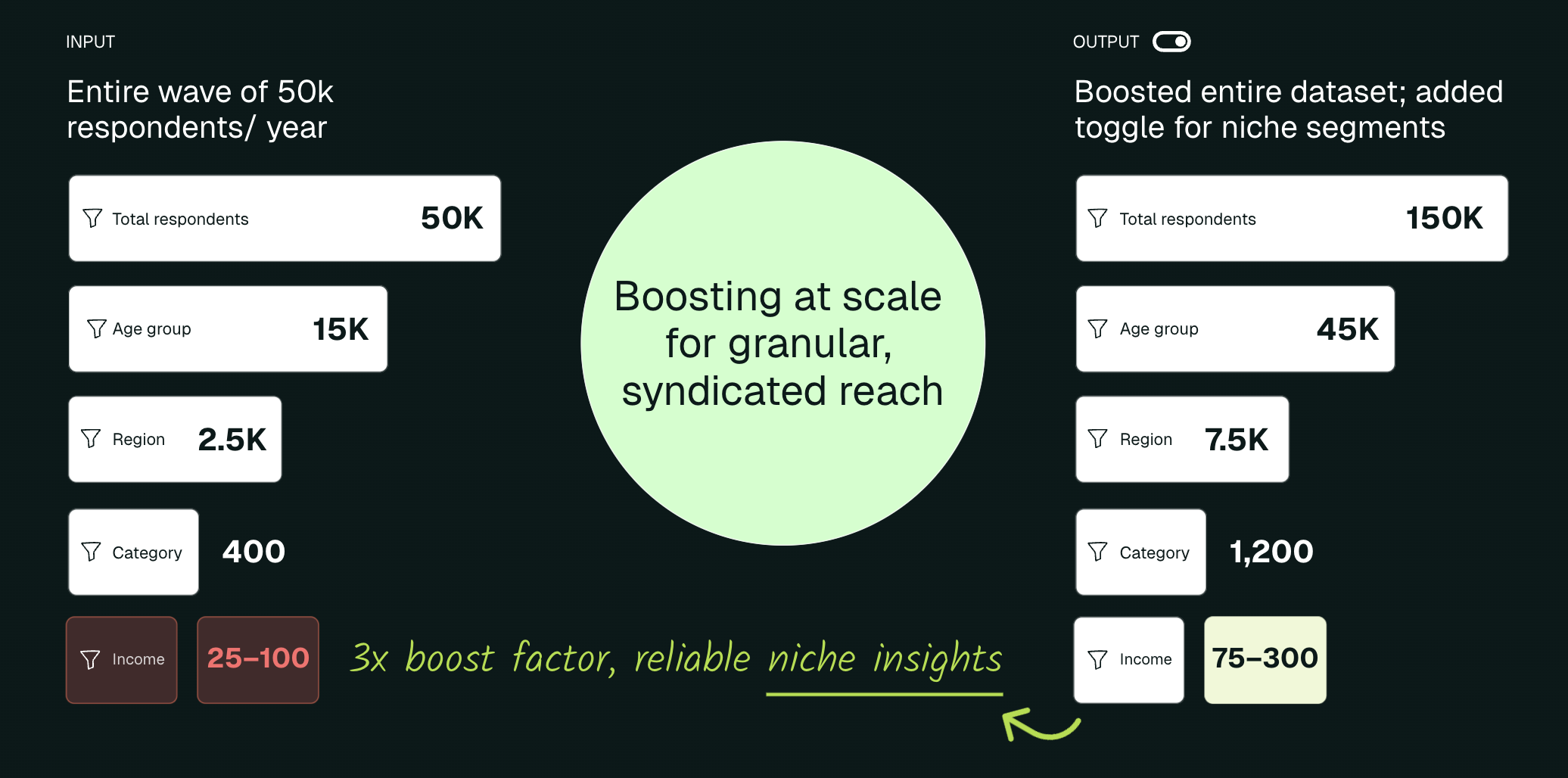
The first visual below illustrates this at a dataset level. A single annual wave of ~50,000 real respondents is used as input. Fairgen boosts underrepresented segments, increasing effective sample sizes by roughly 3×, while preserving the statistical properties of the original data. Researchers can toggle between observed and augmented views for validation and governance.
This approach allowed Big Village and T-Mobile to go deeper into age, region, category, and income cuts without changing the study design or introducing new fieldwork.
The result
Local coverage at scale
Before augmentation, T-Mobile could reliably generate local brand lift insights for 21 of the largest U.S. markets, covering about 35% of the U.S. adult population. Many smaller or mid-sized markets simply did not have enough data to support stable reads.
After applying augmented samples, coverage expanded to 98 markets, representing 70% of the U.S. adult population, using the same nationally balanced survey.
The second visual below shows this shift clearly. On the left, insights are limited to a small number of major markets. On the right, augmented samples unlock meaningful local reads across much of the country.
This made it possible to:
- Measure brand lift at the local level
- Optimize local media with greater confidence
- Run test-and-learn programs on niche audiences
- Do so without the cost or delay of oversampling

Why this matters
For T-Mobile and Big Village, synthetic augmentation was not about replacing traditional research. It was about extending it.
By combining real survey data with carefully validated augmentation, they were able to answer business questions that previously fell outside the limits of sample size.
This hybrid approach allows quantitative research to remain statistically grounded while becoming far more useful when audiences get specific and decisions go local.
Curious about synthetic boosting?
Let's talk
Explore more stories



Ready to trust your data again?
Contact us

