From invisible to analyzable: How Accor unlocked sub-brand insights across 10 global markets


Turning unusable segments to reliable analysis
1 min read
~3,000 variables maintained
zero budget inflation
3x sample sizes
for 6 under-represented segments
No additional fieldwork
full study complexity preserved


Play video
How Accor Made Sub-Brand Performance Visible Across Global Markets
About Accor
Accor stands as Europe's largest hospitality company and the sixth-largest globally, operating 5,700+ hotels across more than 110 countries with approximately 850,000 rooms. With a portfolio spanning 45+ brands from luxury to economy—including Orient Express, Raffles, Fairmont, Sofitel, Pullman, Novotel, Mercure, and ibis—Accor welcomes millions of guests worldwide through its 360,000+ employees.
The ibis brand family sits at the heart of Accor's Premium, Midscale & Economy division, offering accessible hospitality across three distinct sub-brands: ibis Budget (economy), ibis Style (design-focused), and ibis Red (select markets). Understanding performance and perception across these sub-brands in diverse global markets is crucial for Accor's localized strategy and growth planning.
The problem
When sub-brands become invisible in your data
Sky Consulting, a strategic research consultancy working with Accor on a comprehensive usage and attitude study for the ibis brand, faced a challenge familiar to many multi-market researchers: promising study design meeting the harsh reality of low penetration rates.
The study spanned 10 countries—including Australia, Brazil, China, France, Germany, India, and the UK—with robust sample sizes of 700-1,000 respondents per country. At the total brand level, the data looked strong. But when analyzing individual ibis sub-brands within specific markets, the numbers told a different story.
The penetration problem
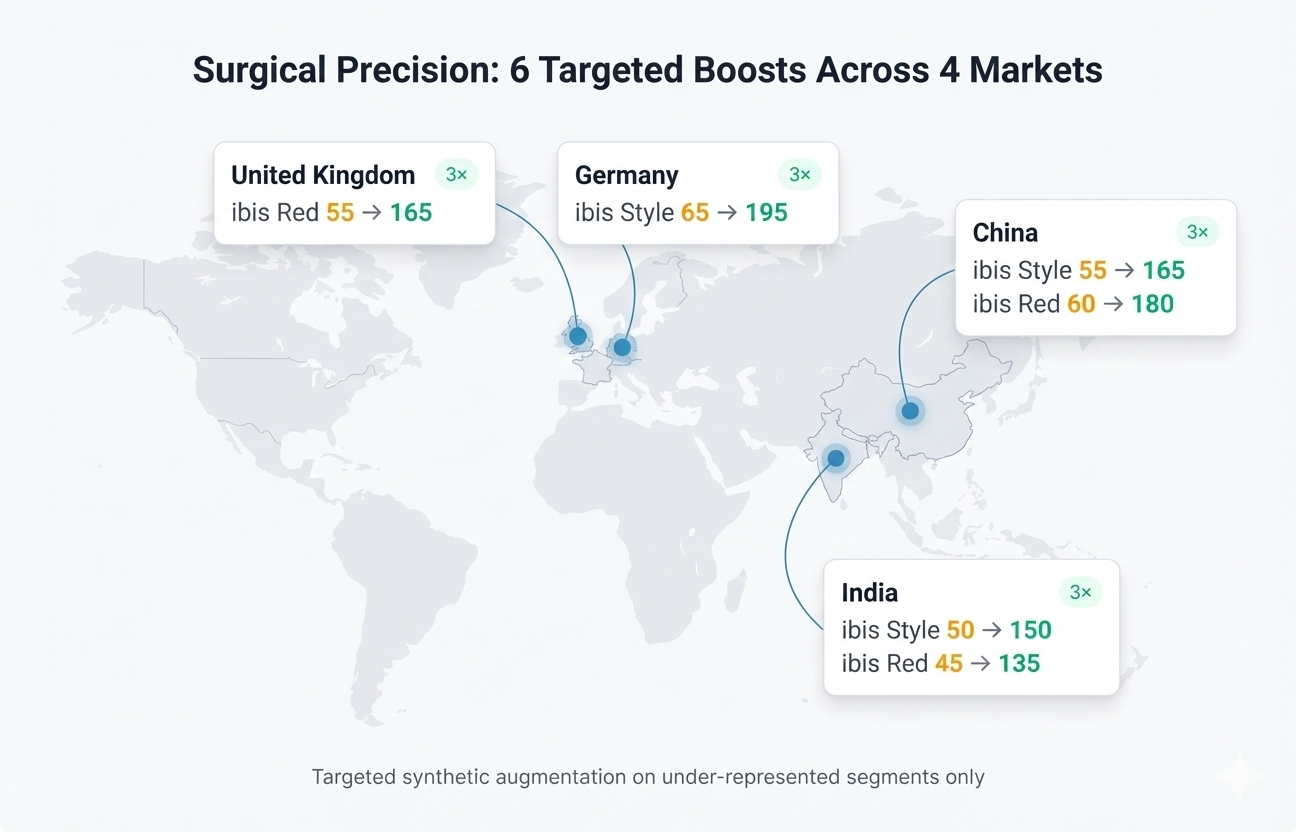
In China, ibis Red showed only 8.6% penetration, translating to approximately 60 expected interviews from a 700-person sample. ibis Style in the same market performed even worse with around 55 interviews. Similar patterns emerged across India, the UK, and Germany for various sub-brands.
For a study examining multiple dimensions—from brand perception to service expectations to competitive positioning—sample sizes of 30-60 respondents per segment push well beyond the limits of statistical reliability. Standard approaches offered no easy solution:
- Oversample each market? Cost prohibitive across 10 countries
- Focus only on major markets? Miss critical regional insights
- Combine sub-brands? Lose the granularity that drives strategy
- Accept high margins of error? Risk decisions on unstable data
As we explored in our article on filling gaps in market research with field augmentation, this represents a classic trade-off between scope and depth that has limited research for decades.
The approach
Augmenting where it matters most
Rather than redesigning the study or accepting reduced analytical scope, Sky Consulting integrated Fairgen's synthetic data boost directly into their workflow. The approach was surgical: identify segments falling below reliability thresholds and augment them by 3x using the existing real respondent data as the foundation.
The technical execution revealed the sophistication of the challenge. This wasn't a simple brand tracking study with 50 questions—the survey contained approximately 3,000 variables spanning multiple question loops, different hotel stay occasions, and various brand interactions. Each boost needed to preserve these complex relationships while maintaining statistical validity.
Fairgen applied 4-5 targeted boosts across the priority markets: China, India, UK, and Germany. Segments with as few as 30-60 real respondents were augmented to 90-180 total respondents, crossing the threshold from statistically unreliable to analytically useful.
The 3x augmentation proved optimal for this scale of complexity—large enough to achieve statistical reliability, yet constrained enough to preserve the patterns and relationships within the original data. Segments starting below 100 respondents consistently reached stable, analyzable sample sizes through this targeted expansion.
This approach exemplifies what we've called "making small samples smarter"—not replacing fieldwork, but extending its analytical reach through validated augmentation.
The result
From data gaps to strategic clarity
The augmentation unlocked what the original fieldwork couldn't deliver: statistically reliable insights at the sub-brand level across all 10 markets.
.png)
The augmentation fundamentally changed what was analytically possible:
- Sub-brand performance could now be analyzed independently within each country, not just at the aggregated ibis level
- Regional differences became visible and measurable across brand perception and usage patterns for ibis Budget, ibis Style, and ibis Red
- Customer segmentation within sub-brands shifted from aspirational to achievable, enabling exploration of behavioral and attitudinal differences
- Localized decisions could be made with confidence, backed by stable data reads
The transformation was particularly striking in markets like China and India, where multiple sub-brands had been analytically invisible. What began as insufficient sample sizes became robust datasets supporting granular segmentation and reliable trend analysis.
The research team had recognized early on that certain populations would be hard to reach and not very numerous across the 10-country study. Rather than accept those limitations or inflate the budget with oversampling, they chose strategic augmentation. The decision proved transformative—turning data gaps into opportunities for the kind of granular, localized insights that drive competitive advantage in hospitality markets.
Why this matters
For Accor, this wasn't about cutting corners or replacing fieldwork. It was about extracting maximum strategic value from research investment already made.
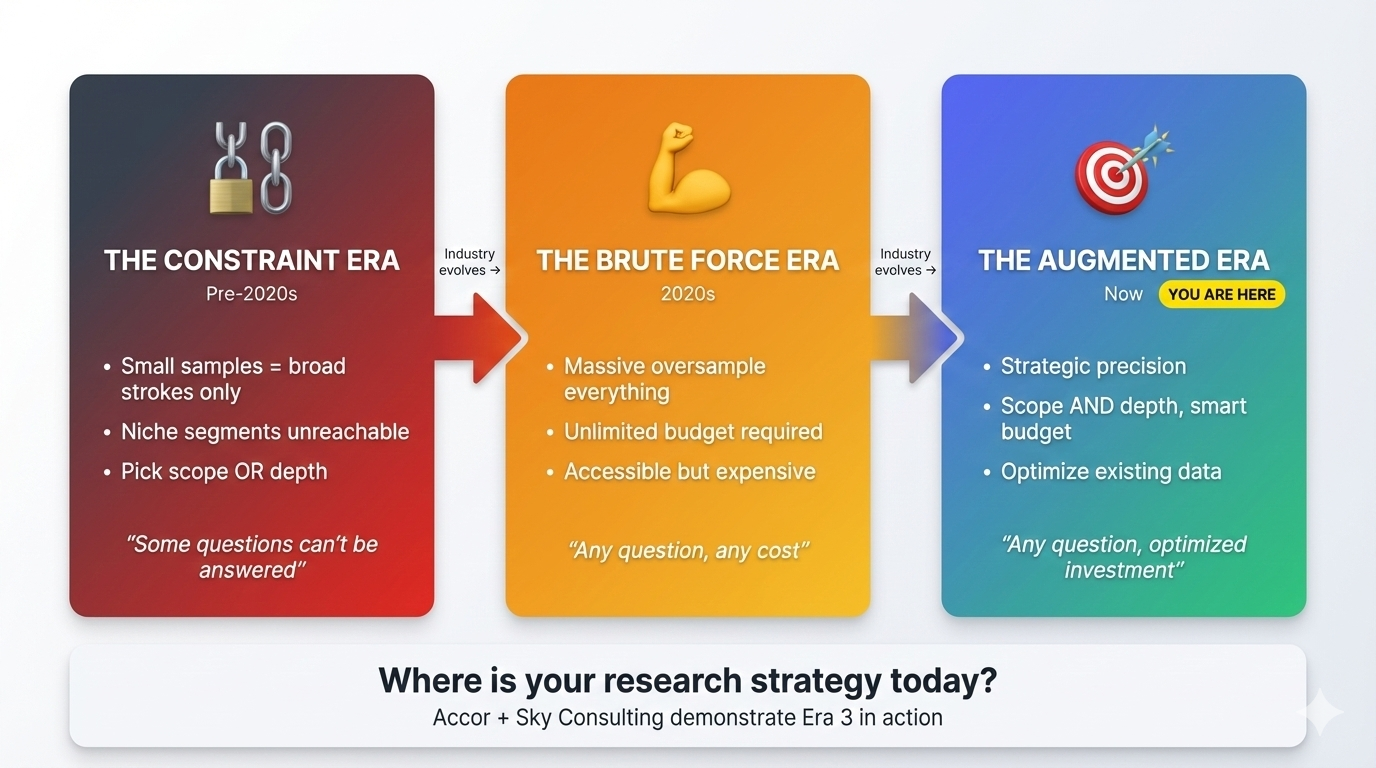
Multi-country studies with diverse brand portfolios face inherent mathematical constraints. Traditional solutions—oversampling or reduced scope—mean either budget inflation or strategic limitation. Synthetic augmentation offers a third path: maintain your study design, collect what's feasible, and extend analytical depth where business questions demand it.
This hybrid approach preserves the rigor of real survey data while expanding what researchers can confidently analyze. For global brands operating complex portfolios across varied markets, that expansion directly translates to better-informed strategy and more precise local execution.
Accor and Sky Consulting demonstrated that with validated augmentation, researchers can finally answer the business questions that matter—even when penetration rates say they shouldn't.
Curious about synthetic boosting?
Let's talk
Explore more stories




Ready to trust your data again?
Contact us

