.webp)

US Cosmetics & Makeup Consumers: Who They Are, How They Buy, What Moves Them
Original primary research on 467 US adults who bought makeup in the past 6 months. Five things every brand, retailer, and agency.
- Panel: Appinio — verified US consumer panel
- 467 respondents · 199 variables
- April 2026; Digital Twins available via Fairgen
Heading
The American makeup buyer in 2026
The US makeup consumer is not who most brand managers picture. She — and increasingly he — is not a Gen Z TikTok devotee browsing Sephora. The median US makeup buyer is 25 to 44 years old, buys primarily at Walmart or Target, and has been loyal to the same two or three brands for years. 90.8% of these buyers make their own purchase decisions, with no partner or family member involved. This is a sovereign consumer.
She wears makeup frequently — 39.8% every day, another 19.7% four to five times a week — and she knows exactly what she wants. Her primary purchase criterion is not trend, not influencer endorsement, not even price. It is formula. 83.1% of buyers rate formula and finish quality as the most important factor in any purchase decision. If the product does not perform, nothing else matters.
She splits across two price tiers: 30.6% buy mostly drugstore (under $15 per item) and 30.6% buy mid-range masstige ($15–$30). Another 23.6% buy prestige. This is not a premium market locked away in Sephora — it is a broad, mass-market category with a meaningful prestige tail. Brands that ignore the $50 monthly buyer at Ulta are leaving real revenue on the table; brands that ignore the Walmart shelf are building on sand.
Social media matters, but not in the way most marketers assume. 62.7% of buyers have made a purchase influenced by social media or an influencer in the past six months. But the #1 stated influence at point of purchase is still a friend or family recommendation (37.3%), followed by in-store discovery (31.7%). TikTok is a discovery engine. The shelf closes the sale.
The most important strategic tension in this market: this audience is loyal until she has a reason not to be. 37.7% of buyers would absorb a 15% price increase without switching. But 54% would leave if a cheaper option appeared and 31.9% would leave if formula quality declined. Retention is built on product performance, not on loyalty programs or social equity.
Audience at a glance · n=467
90.8%
Sole purchase decision maker
39.8%
Wear makeup every day or almost every day
62.7%
Have bought a product because of social media in the past 6 months
83.1%
Rate formula quality as most important purchase factor
$30–79
Monthly spend for 39.8% of buyers — 24.4% spend $80 or more
70%
Rate inclusive shade ranges as appealing — #1 trend demand signal


The algorithm gets the credit. The shelf gets the sale.
Every brand manager in beauty right now is asking how much to spend on TikTok. Here is what the data actually says: TikTok influences 27.2% of buyers. Instagram: 22.9%. YouTube: 24.6%. Influencer content: 23.6%. These are meaningful numbers. But none of them is the #1 conversion driver.
The #1 influence driver at point of purchase is friend and family recommendation at 37.3%. Second is in-store discovery — seeing a product on the shelf at Ulta, Sephora, or Target — at 31.7%. The purchase funnel is not a straight line from TikTok to cart. It goes: TikTok creates curiosity, a friend confirms it, the shelf provides the last push.
For brands allocating marketing budgets, this has direct implications. Mass retail distribution — Walmart, Target, drugstores — reaches 58%, 37.9% respectively. You cannot out-TikTok your way to conversion if your product is not findable at the shelf your customer walks past three times a week. Social spend without retail presence is building at the top of the funnel with no bottom.
TikTok Shop, the direct-to-purchase social commerce play, only captures 13.3% of buyers. The hype around social commerce in beauty is real — but the actual purchase behavior has not shifted to match the narrative yet.
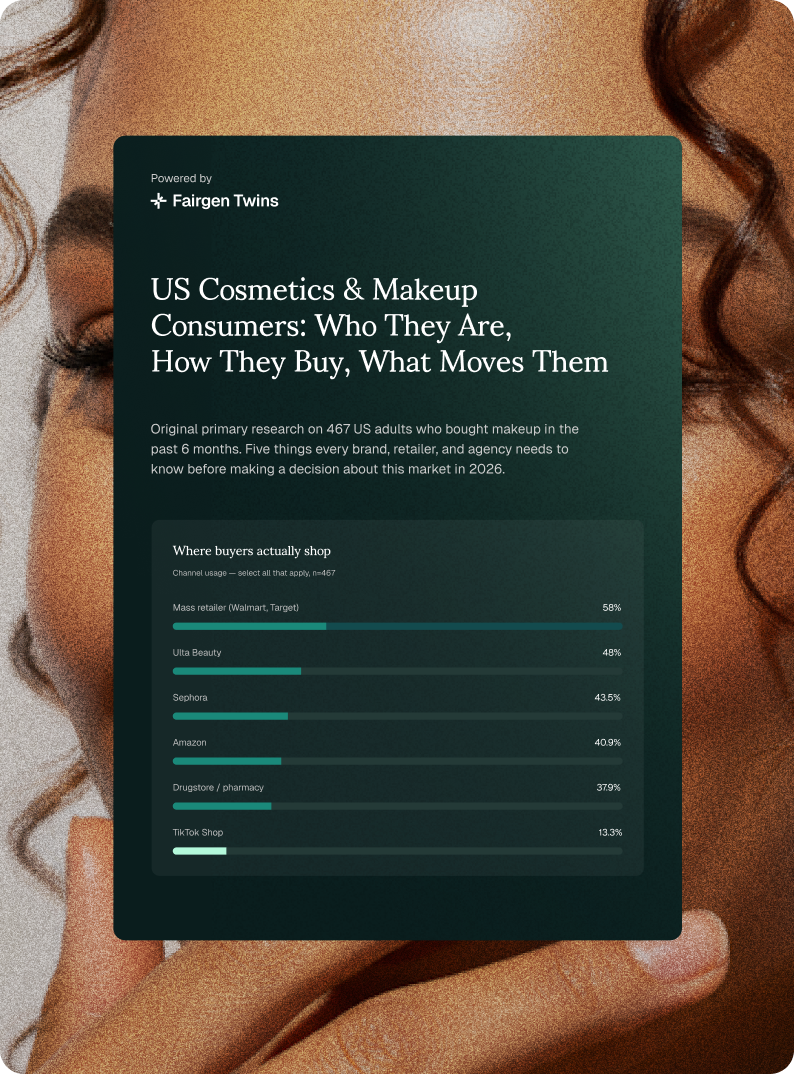
Where buyers actually shop
Channel usage — select all that apply, n=467
Mass retailer (Walmart, Target); 58%
Ulta Beauty; 48%
Sephora; 43.5%
Amazon; 40.9%
Drugstore / pharmacy; 37.9%
TikTok Shop; 13.3%
"In-store discovery beats TikTok as a conversion driver by 4 percentage points. The shelf is still the most underrated marketing channel in beauty."

83.1%
Rate formula and finish quality as extremely or very important — the #1 purchase factor, above price, shade range, and brand trust.
31.9%
Would switch brands if formula quality or performance declined — equal weight to finding a discount elsewhere (33%).
"Brands that win on formula are more defensible than brands that win on price. Price can be matched overnight. A foundation that works cannot."
Formula is the real moat. Not marketing, not loyalty programs.
In a category saturated with influencer content, celebrity collaborations, and loyalty tiers, the actual driver of retention is product performance. 83.1% of buyers rate formula and finish quality — coverage, longevity, color payoff — as extremely or very important. This outranks price (76.9%), shade range (79.4%), and brand trust (74.9%).
The implication cuts in two directions. For mass-market brands like Covergirl and Maybelline — which dominate primary brand share for face makeup with 21.4% and 24.6% respectively — the risk is not losing to a viral indie brand. It is formula fatigue. If a product stops performing (broke out skin, changed formula, discontinued a shade), 31.9% of buyers name formula decline as a top switch trigger.
For prestige and indie brands trying to convert mass-market buyers, the data is actually encouraging. 79.4% of buyers consider shade range and inclusivity as an important purchase factor — which is where many prestige brands have an inherent advantage. Fenty's 40-shade standard, once a differentiator, is now a baseline expectation.
The skinification of makeup — adding skincare ingredients like SPF, hyaluronic acid, and niacinamide to foundation and concealer — resonates with 72.8% of buyers rating skincare benefits as important. This is not a niche play. It is becoming a table-stakes feature in the base makeup category.
Shade range is the biggest unmet demand signal in the category.
Inclusive shade ranges — foundations and concealers offering 40 or more shades across undertones — score 70% high appeal among all 467 buyers surveyed. This is the single highest trend demand score in the entire study, above skinification (64.7%), clean and vegan claims (61%), and lip oils (59.5%).
But the demand signal goes deeper than a preference score. 79.4% of buyers rate shade range as extremely or very important when evaluating a brand. 49.7% say checking their shade is the first thing they do. And 33.2% say they simply will not buy from a brand that does not carry their shade.
What is striking is the gap between awareness and resolution. Fenty's 40-shade launch in 2017 changed the category — yet this audience still ranks shade range as a pain point. The frustrations surfacing in open-ended responses center not on shade count, but on undertones: finding a product online that matches in-store, and getting foundation undertone right without being able to test.
For DTC brands and retailers investing in virtual try-on or shade-matching tools, this data is a green light. The demand is confirmed. The execution gap is still open.
Trend appeal — what buyers actually want
% rating 4 or 5 out of 5 — all 467 buyers
Inclusive shade ranges (40+); 70%
Skincare-hybrid makeup; 64.7%
Clean / vegan / cruelty-free; 61%
Lip oils & tinted treatments; 59.5%
Press-on nails / at-home gel; 50.1%
Viral TikTok products; 44.3%
56.7% aware of skincare-hybrid trend
53.3% aware of lip oil trend
36% aware of press-on nail trend
Trend appeal — what buyers actually want
% rating 4 or 5 out of 5 — all 467 buyers
Inclusive shade ranges (40+); 70%
Skincare-hybrid makeup; 64.7%
Clean / vegan / cruelty-free; 61%
Lip oils & tinted treatments; 59.5%
Press-on nails / at-home gel; 50.1%
Viral TikTok products; 44.3%
54%
Name price increase or finding a cheaper option as a top brand switch trigger — but only 25.7% would actually switch at +15%. The gap between stated sensitivity and real behavior is wide.
Price sensitivity is real but overstated. Most buyers are stickier than they think.
Every brand in beauty is scared of being priced out. The data suggests the fear is at least partially misplaced. When buyers were asked what they would actually do if their favorite product increased in price by 15%: 37.7% said they would continue buying as usual. Another 35.3% said they would buy less frequently. Only 25.7% said they would switch to a cheaper alternative outright.
The gap between stated sensitivity and revealed behavior is a critical insight for pricing strategy. 54% of buyers name price as a theoretical switch trigger— but when faced with a concrete 15% increase, only a quarter actually defect. The other three quarters either absorb the increase or reduce frequency while staying brand-loyal.
This matters differently across price tiers. A prestige buyer absorbing a $3 increase on a $50 foundation is in a different position than a drugstore buyer absorbing the same increase on a $12 mascara. The relative price increase matters more than the absolute dollar amount. Mass-market brands have less pricing headroom per item but more item volume to manage.
The practical implication: price increases in cosmetics are survivable if communicated alongside a formula improvement or packaging upgrade. Pure price increases with no value story are the most likely to trigger the 33% who would switch if a discount appeared elsewhere.
The repeat purchase is where most brands win or lose. Not the trial.
43% of buyers describe themselves as very often or often trying new brands — a few new products per month. On its face, this looks like a category with high churn and high receptivity to new entrants. But the other side of the data complicates the picture: 35.3% only buy new products a few times a year, and 9.6% rarely or almost never switch.
The trial problem in makeup is not acquisition — it is conversion from trial to repeat. The top categories bought (face/base at 74.5%, eye at 74.3%, lip at 66.4%) are also the categories buyers are most reluctant to abandon. 35.3% would be most reluctant to give up their face makeup, 27% their eye makeup. These are high-stakes, high-repetition categories where getting the product right means decades of loyalty.
Nail products (50.3% bought in past 6 months) and makeup tools (44.5%) represent underappreciated cross-sell categories. A brand with a strong foundation or mascara has existing trust that can be leveraged into nail, brow (39.6%), or tools — without needing to rebuild the credibility equation from scratch.
The friend recommendation (37.3% influence driver) is effectively a word-of-mouth conversion from a trial. The highest-ROI marketing investment for this audience is making the product good enough that existing buyers tell their network. No amount of paid reach replicates the conversion rate of a peer recommendation in this category.
74.5%
Bought face/base makeup in the past 6 months — tied with eye makeup (74.3%) as the highest-penetration categories. Both are also what buyers least want to give up.
Face makeup brands used — secondary usage
Multi-brand portfolio — select all that apply, n=467
Maybelline; 24.6%
Covergirl; 21.4%
L'Oréal Paris; 18.4%
e.l.f. Cosmetics; 15.8%
Revlon; 13.3%
Fenty Beauty; 7.9%
Complete data profile — n=467
All key metrics from the survey for reference and citation.
Demographics
23.3% Age 25–34
22.5% Age 35-44
18.6% Age 45–54
71.7% Female
29.3% Income $25K–$49K
21.6% Income $50K–$74K
Purchase behavior
39.8% Daily+ makeup use
19.7% 4–5x/week
62.7% Social-media driven purchase
39.8% Spend $30–$79/mo
24.4% Spend $80+/mo
30.4% Spend increased vs. last yr
Price tier
30.6% Drugstore / mass (<$15)
30.6% Mid-range masstige ($15–$30)
23.6% Prestige ($30+)
10.9% Mix of mass + prestige
4.3% Luxury ($50+)
Switch triggers
54% Price increase / cheaper option
33% Discount at another brand
31.9% Formula quality decline
23.3% Shade discontinued
17.1% Social media viral product
17.1% Skin sensitivity change
Importance factors (% rating 4–5)
83.1% Formula & finish quality
79.4% Shade range
76.9% Price / value
74.9% Brand trust
72.8% Skinification benefits
58.7% Clean / vegan claims
Channels & influence
58% Mass retail (Walmart/Target)
48% Ulta Beauty
43.5% Sephora
37.3% Friend / family influence
31.7% In-store discovery
27.2% TikTok influence

What digital twins revealed about this audience
Survey data tells you what happened. Digital twins let you ask why — and test what you'd do about it. Here is what surfaced when we ran studies on this exact population.
- On shade frustration beyond the numbers: Twins describe a specific failure pattern — they find a foundation online, buy it, and get the undertone wrong. The problem is not shade count. It is undertone detection without physical testing. Brands with virtual try-on tools see dramatically higher trust scores among this population before purchase.
- On the TikTok-to-shelf journey: Twins describe TikTok as sparking curiosity, not closing intent. The actual purchase sequence is: see it on TikTok, check reviews on Reddit or Sephora within 24 hours, then make the decision in-store or on Amazon. Brands treating TikTok as a direct-purchase channel are skipping a critical middle step.
- On price sensitivity by tier: Prestige buyers are largely insensitive to small increases on their prestige SKUs but highly sensitive to value in drugstore categories — they benchmark everything against the best drugstore version they know. Mass-market buyers trade down on color products before skincare-hybrid formulas. The hierarchy is: never sacrifice performance, sometimes accept less color.
This audience is available for study. Run concept tests, claims validation, pricing research, or ad creative testing against these 467 buyers.
Questions about the US cosmetics market
Get your free PDF report
Lorem ipsum dolor......rem ipsum dolor. Rem ipsum dolor, rem ipsum dolor......

Every brand makes hundreds of decisions a year that need customer input but can’t justify a $10K study.New copy. A pricing change. Three concepts in development. A campaign about to go live. Real research takes 3 to 6 weeks and costs $5K to $200K. So most of those decisions get made without any customer signal at all.
Fairgen Twins sits in that gap.
It’s a marketplace of digital twins: simulated versions of real, named respondents built from premium panel data. You pick an audience, run a study, and get a full research deck in 20 minutes. Quantitative results, qualitative themes, direct quotes from individual twins, and a recommendation summary.
Or skip the structured study. Pick any twin in the audience and talk to them directly. Ask follow-up questions, push back on their answers, go wherever the conversation goes. It works like a depth interview, without the scheduling.
Teams with their own research data can also build private audiences. Upload your own quant and qual research (interviews, surveys, reports), and Fairgen turns it into a set of simulated respondents you own and can query anytime.
This is directional research, not a replacement for field studies. We say that upfront. Twins is for the decisions before the big study, and for the hundred smaller decisions that will never get one.
No. You can start with the marketplace immediately.
The marketplace hosts premium audiences built using premium data. They’re ready to use the moment you sign up. No upload, no setup.
If you want to build a private audience from your own data, that requires uploading your quantitative dataset through the audience creation wizard.
The two options are independent. You can use marketplace audiences today and build private audiences later.
Marketplace audiences are built with data providers, using custom and syndicated data. They are available immediately. No upload required.
Private audiences are built from your own data. Upload a dataset, optionally add transcripts and reports, and get a simulated audience visible only to your account. Build once, test endlessly.
Check the marketplace first.
New audiences are added every week across B2C and B2B categories and geographies. If you need a segment you haven’t researched yourself, a partner may have already built it. Worth a look before assuming you need to start from scratch.
If the audience genuinely doesn’t exist in the catalog and you have no primary data on that group, Fairgen can’t simulate them. We build twins from real respondents. You’d need to collect that data first. Once you have it, the audience lives on the platform indefinitely.
No. Fairgen’s can augment only quantitative fields.
Related audience research



Make every decision an informed one
467 verified US makeup buyers are available as digital twins. Ask them anything — pricing, shade ranges, new concepts, ad creative — before you go to market.
Need a full study? Launch research on this audience — bring your customer into the room for every decision.


Get your free report
467 verified US makeup buyers are available as digital twins. Ask them anything — pricing, shade ranges, new concepts, ad creative — before you go to market.